
Call For Consultation

Call For Consultation
CT SUPREME COURT WEEDS OUT APPEAL AGAINST RE-HIRE OF POT SMOKING STATE EMPLOYEE
- posted: Aug. 30, 2016
- Labor & Employment, Supreme Court Rulings
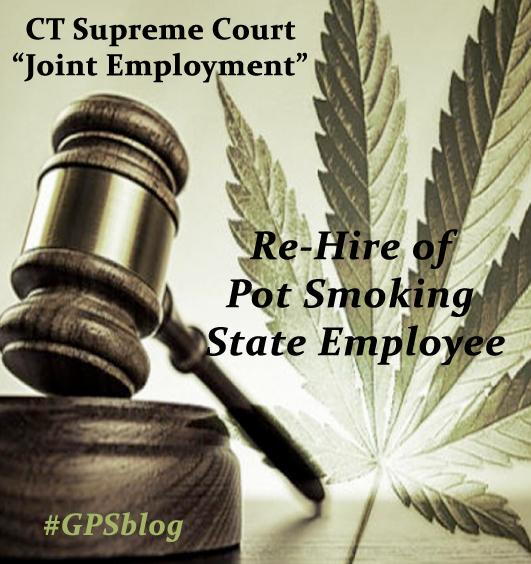
A state employee was fired for smoking marijuana during work hours in a state vehicle on state property. Sounds reasonable, right? If you answered yes, a recent decision by the Connecticut Supreme Court may surprise you.
Less than two hours into his 4pm to midnight shift at the University of Connecticut Health Center, a state employee was caught smoking marijuana with a coworker while sitting in a state van parked on the health center campus. He was subsequently terminated.
After his termination, the employee, through his union, challenged his termination in arbitration. Typically, collective bargaining agreements (contracts between employers and unions) provide for final and binding arbitration as a way to resolve disputes like this one. The arbitrator in the case ordered that the employee should be reinstated, with the following (severe) sanctions and conditions: (1) six month suspension without pay; (2) a last chance status (i.e., one more strike and you’re out); and (3) random drug testing. The state did not agree with that decision and appealed to the trial court, which overturned the arbitrator’s decision because the employee’s actions violated public policy (and criminal laws) of the state.
Generally, courts do not like to reverse arbitration decisions, even if they disagree with those decisions or find them otherwise flawed, because the law encourages arbitration (especially when the parties involved mutually agree to it like this case). This is the principle that the Connecticut Supreme Court reaffirmed when it overturned the trial court, thereby reinstating the employee in accordance with the arbitrator’s decision. The Court considered important many of the same facts as the arbitrator, including the employee’s 15-year career without discipline and his serious personal struggles at the time, which caused stress and anxiety (he believed that smoking marijuana helped alleviate that stress and anxiety).
To be clear, the Court agreed with the trial court that there is a well-defined public policy in Connecticut “against the recreational use of marijuana, particularly in the workplace,” but the Court disagreed that this was one of the rare instances where the court should disturb an arbitration decision.
This case does not mean that employees can smoke pot (or do other drugs, for that matter) at work without losing their jobs. It is more about preserving the meaning of final and binding arbitration. Interestingly, a non-union employee caught smoking pot at work almost certainly would not have been reinstated. Employees in unions usually have the benefit of a just cause provision in the collective bargaining agreement, which means they are not at-will employees and, therefore, the employer needs cause to discipline (including terminate) them.
- Business & Contracts (28)
- Covid19 (16)
- Criminal & Traffic Defense (27)
- Elder Law (26)
- Finance (3)
- Firm News (5)
- Foreclosures (2)
- Injury & Accidents (58)
- Insurance Law (18)
- Labor & Employment (61)
- Product Liability (1)
- Personal Injury (72)
- Family Law (1)
- Bankruptcy (1)
- Auto Injury (16)
- Estate Planning (11)
- Workers Rights (1)
- Business Law (2)
- Wills and Probate (1)
- Truck Accidents (7)
- Divorce (1)
- Employment (5)
- Auto Accident (10)
- Pedestrian accidents (1)
- Dog bites (2)
- Bicycle Accidents (2)
- Nursing Home (1)
- Catastrophic Injury (2)
- Legislative (1)
- Wrongful Death (1)
- Auto accident (3)
- Slip and fall (5)
- Motorcycle accidents (4)
- Public entity lawsuits (1)
- Estate planning (3)
- Burn injuries (2)
- Nursing home injury (1)
- Premises Injury (2)
- Employment Law (3)
- Automobile Injury (3)
- Pool Injury (1)
- Work Injury (1)
- Sidewalk Injury (1)
- Firearms Injuries (1)
- Mediation (1)
- Attorney-Client Privilege (1)
- Traumatic Brain Injuries (1)
- E-Bike (1)
- Landlord & Tenant (7)
- Litigation (38)
- Medical Malpractice (8)
- Municipal Law (3)
- Real Estate (50)
- Supreme Court Rulings (5)
- Trusts, Estates, Wills & Probate (34)
- Workers' Compensation (12)
- Zoning, Planning & Land Use (3)
Contact Us
Please tell us about your legal matter and a member of our staff will contact you.
Map & Directions

Gesmonde, Pietrosimone & Sgrignari, L.L.C. is located in Hamden, CT and serves clients in and around North Haven, Hamden, Waterbury, Bethany, Milford, Wallingford, Prospect, Woodbridge, Northford, Madison, Beacon Falls, Branford, Cheshire, North Branford, East Haven, Naugatuck, Meriden, Ansonia and New Haven County.
Attorney Advertising. This website is designed for general information only. The information presented at this site should not be construed to be formal legal advice nor the formation of a lawyer/client relationship. [ Site Map ]
See our profiles at Lawyers.com and Martindale.com
Martindale-Hubbell and martindale.com are registered trademarks; AV, BV, AV Preeminent and BV Distinguished are registered certification marks; Lawyers.com and the Martindale-Hubbell Peer Review Rated Icon are service marks; and Martindale-Hubbell Peer Review Ratings are trademarks of MH Sub I, LLC, used under license. Other products and services may be trademarks or registered trademarks of their respective companies. Copyright © 2026 MH Sub I, LLC. All rights reserved.
